
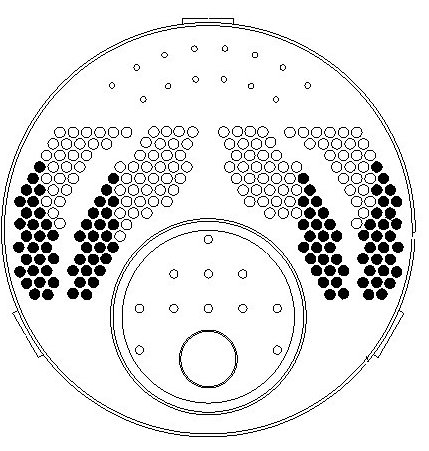
Dead zone in boiler tubes at part load with zero or very little heat transfer due to lack of temperature difference. The more tubes the worse. Not happening in Warga boiler.
The Warga boiler design uniquely integrates the best features of all fire-tube boiler families—including 2-, 3-, and 4-pass configurations, as well as wetback and dryback designs—without inheriting their associated drawbacks. This integration is unmatched in the industry. No more 2-,3-, and 4-pass, dryback and wetback variations by industry's first Common platform.
A key differentiator lies in Warga's optimized furnace volume and highly optimized tube configuration, driven by a deep understanding of heat transfer dynamics. This design ensures that flue gas velocity remains within the optimal range for maximum heat exchange efficiency, even at partial loads. By contrast, the Scotch marine boiler—characterized by a grossly excessive number of tubes—suffers from poor Input/Output (I/O) efficiency during low-load operation, which is typically the dominant mode in most applications.
As the temperature of the flue gas, heat transfer surface, and surrounding water/steam begin to converge, the temperature gradient—critical to effective heat transfer—collapses. Consequently, the rate of thermal exchange plummets, resulting in minimal energy being transferred for steam or hot water generation. Thermodynamically, this constitutes a clear loss.
This inefficiency is not readily apparent from flue gas analyzer readings, which rely solely on temperature and composition. Such readings may significantly overstate the true thermal efficiency, masking the degradation in actual I/O performance at partial load.
It follows that a boiler optimized for tube surface can achieve higher Input/Output (I/O) efficiency even with higher flue gas temperatures compared to one where the flue gas temperature is close to that of the surrounding heat transfer surfaces. This counterintuitive result stems from maintaining a sufficient temperature gradient to sustain effective heat transfer.
This discrepancy in efficiencies is well recognized in practice but often dismissed as "unaccountable loss." The issue is especially pronounced in Scotch marine boilers due to their excessive tube-to-furnace surface area ratio, which commonly exceeds 12:1. For example, a 400 HP Scotch marine boiler typically includes over 2,000 sq.ft. of heating surface, while the Warga boiler achieves superior performance with under 1,000 sq.ft., representing more than a 50% reduction in surface area!
In the Warga boiler design, the tube-to-furnace area ratio is as low as 3:1 or less, enabling the furnace to absorb up to two-thirds of the total heat input, compared to one-third or less in Scotch marine designs. This results in significantly lower efficiency losses at partial load, translating directly to reduced fuel consumption. This performance has been proven in long-term operation.
Furthermore, in conventional Scotch marine boilers, both front and rear doors are located in high-temperature zones and must be lined with refractory. This refractory provides no thermal contribution and exists solely because bare steel cannot withstand the extreme temperatures. In the Warga design, this problem is resolved by designing the door as a pressurized extension of the boiler shell—an industry-first innovation – fully proven for 25+ years.
Refractory is a heat sink trapping heat, an unproductive and costly process, which extent few are aware of. The refractory radiates back, however the radiated heat is constantly replenished taking the heat away from the productive process of f.i. steam generation. Be it the best burner, the most sophisticated combustion controls, the best maintenance etc., the refractory-trapped heat is not affected permanently impacting economics of boiler operation. Hardly anyone is aware of its extent because the refractory-trapped heat is invisible to standard boiler efficiency calculation method, which is based solely on flue gas composition and temperature. Input/Output method lays the refractory-related waste bare for all to see and it's staggering as follows.
Figures from the US site with Warga boilers for customer's original boilers (approximation):
- boiler refractory bulk density: 149.8 lb/cu.ft.
- boiler refractory specific heat capacity: 0.239 BTU/lbF
- room temperature: 86F
Front door
- refractory mass: 3175 lbs
- refractory inner side temperature: 2002F
- refractory outer side temperature: 282F
- refractory average temperature: 1142F
- refractory heat content: 841.586 MMBTU
Formula: refractory mass x refractory specific heat capacity x ( refractory average temp. - room temp.)
Rear door
- refractory mass: 1058 lbs
- refractory inner side temperature: 474F
- refractory inner side temperature: 173F
- rear door refractory average temperature: 324F
- refractory heat content: 73.631 MMBTU
Recap
- Total refractory mass: 4234 lbs
- Total stored heat in refractory: 915.217 MMBTU
- Equivalent gas amount to stored heat in refractory: 909 cu.ft.
- Average gas rate: 12.714 cu.ft./h
- Average gas rate to maintain stored heat in refractory: 7.1% (theoretical)
(Formula: equivalent gas amount to stored heat in refractory / average gas rate)
Note: The actual figure for the gas rate to maintain stored heat in refractory is lower as part of the heat refractory radiates back is transferred to water, yet it gives an idea on the extent of waste going unnoticed.
To maintain the heat stored in refractory a noticeable amount of the incoming energy from fuel is unproductively consumed. A waste Warga boiler design is free from, along with refractory maintenance-related problems and associated costs. Boilers are meant to heat water not a concrete, a task Warga boiler design meets in full as proven in 25+ years of 24/7 problem-free operation at a site in USA.